
June 8, 2026
Honouring a connection to living history at tinwis
As told to Erin Linn McMullan
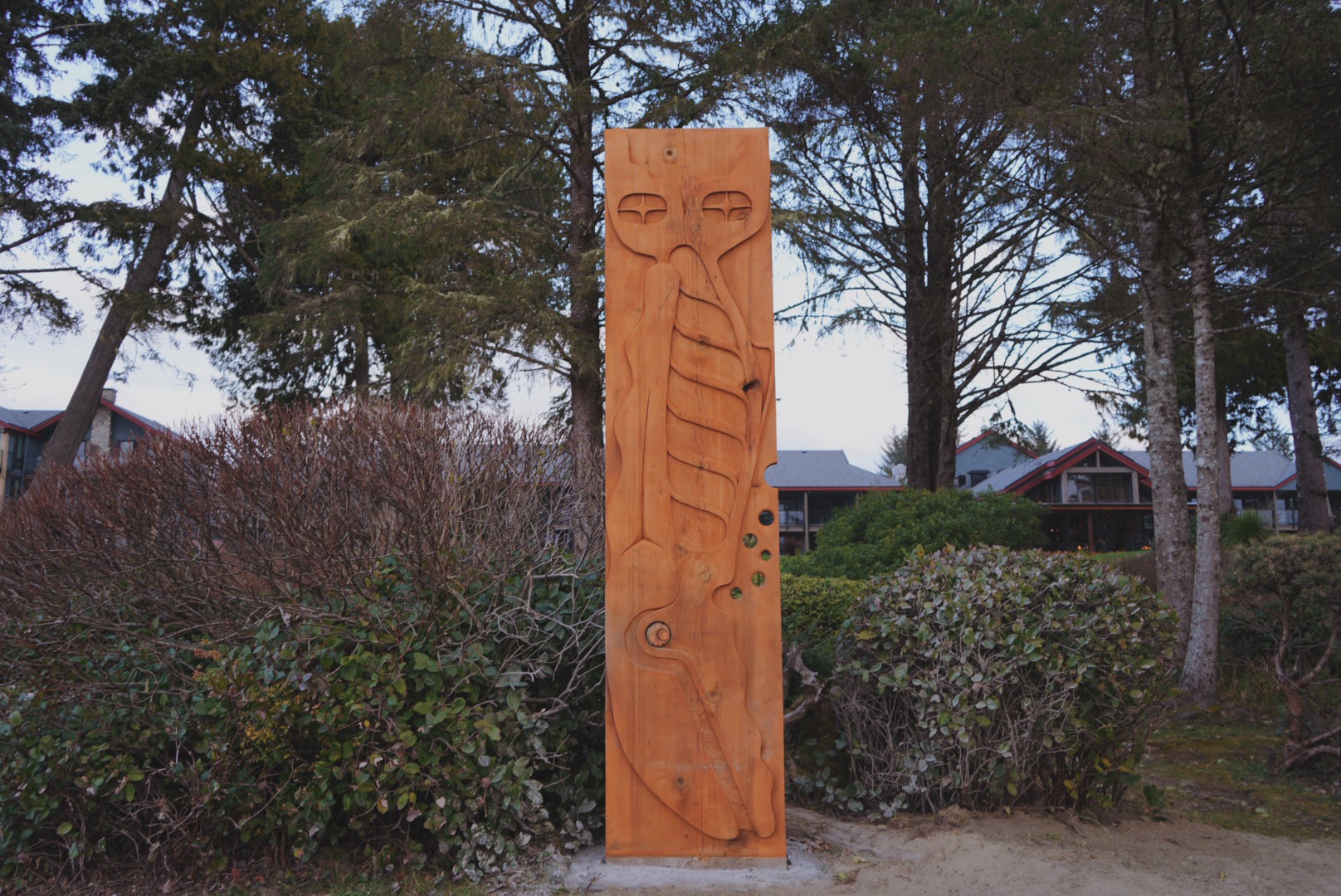
Nestled about five meters above the high tide mark on the dunes at tinwis, stands a new č̓iin̓uł (totem pole): ʔiiḥtuup (humpback whale) diving into that liminal space where sand meets sea. In a house post style carved from salvaged cedar, the whale’s rostrum plunges towards the ocean’s depths, its copper eye flashing in the sunlight. Cut-out bubbles float up to the surface, revealing blue-green leaves rippling in the breeze like waves.
“Humpback whales have this really beautiful, communal way of fishing where they actually make a net out of bubbles,” explains ƛaʔuukʷiʔatḥ interdisciplinary artist Tleḥpik Hjalmer Wenstob. “I was going to carve these orb-y bubbles then I had this idea of drilling right through the panel so you can look right through them.”
Because it’s a panel, it allowed for experimentation, inspiring him to try the same drilling technique on a sister piece at the daycare in Ty-Histanis. There, the open beak of a raven appears to catch the sun when it lines up during summer solstice.
This flatter panel honours the carved house posts integral to nuučaan̓uł longhouse architecture, providing its foundational support.
While the whale was originally intended for Grice Bay, its installation was delayed by the deactivation of the road, and it found its true home.
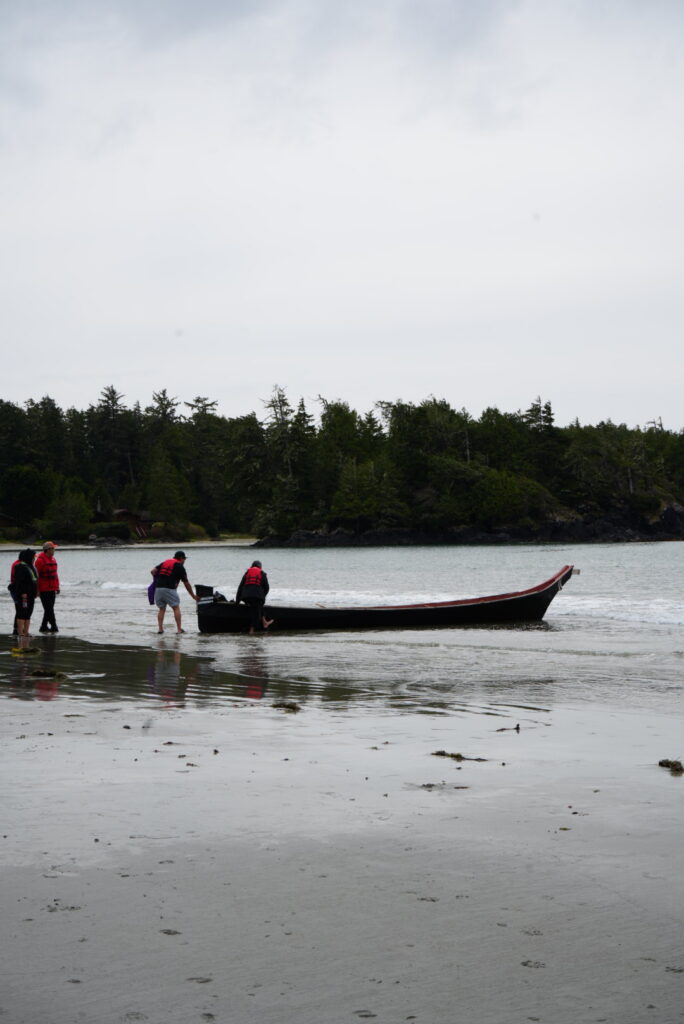
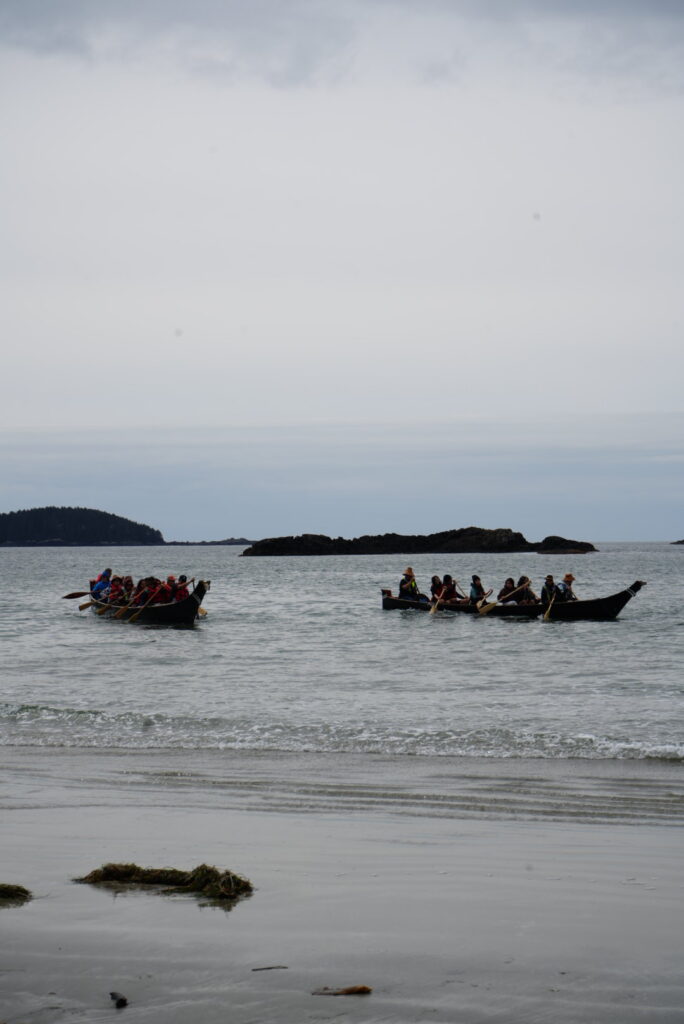
With the restoration of the name tinwis, this site seemed especially fitting. Here, where č̓iin̓uł once lined the oceanfront at an important village site and where dugout canoes still pull ashore today.
April 17th, 2026
“It should be here as it was in the past,” he observes.
Clearing the cedar from his lungs, Hjalmer continues, “My own ancestors, my great-great grandfather, had a whaling shrine at the corner of that beach.” That spruce tree filled with implements was later felled by MacKenzie, by whose name the beach was briefly known.
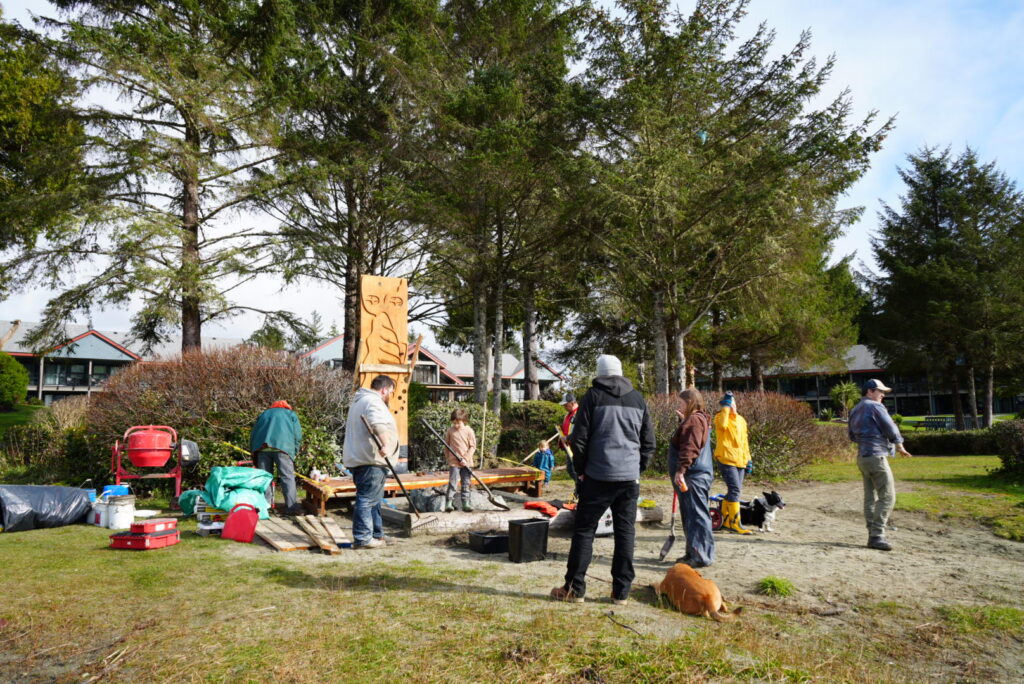
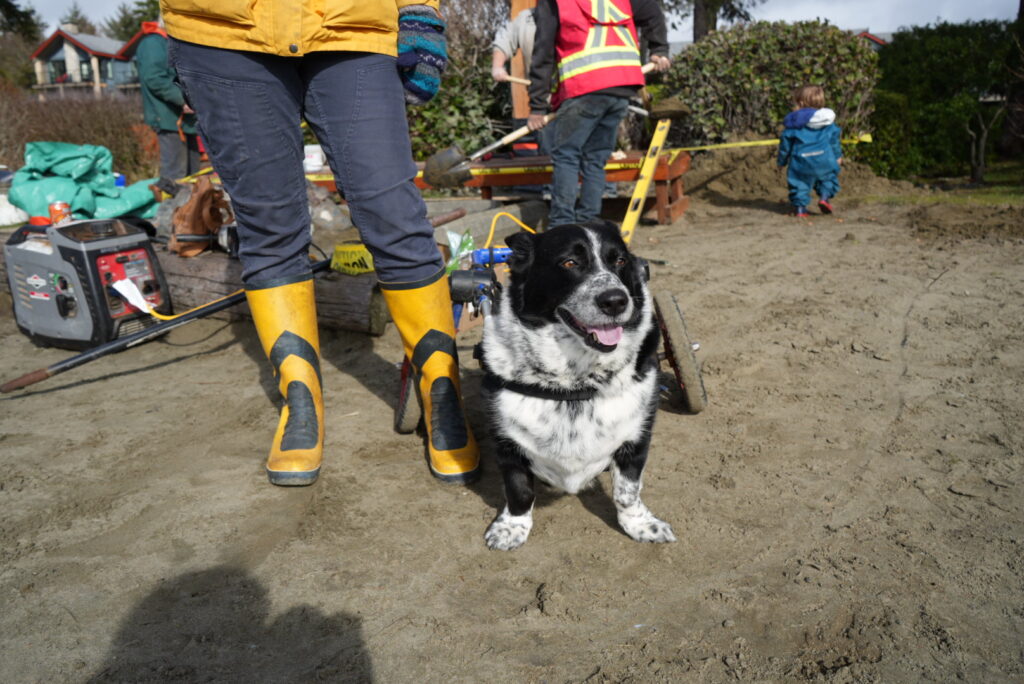
Everyone from Hjalmer’s grandfather to his children, daughter Huumis, and sons Cinkwa and Tsaahtis, helped install the whale here next to the family’s favourite firepit. When the č̓iin̓uł was anchored, Hjalmer recounts that his mother wrote into the drying concrete, “In memory of Masso”. “Masso was our ancestor who had that whaling shrine at the beach at tinwis.
“The pole goes up for our kids, and it goes up for future generations, but it also really goes up for our ancestors who were there.
“We’re going to have to go and have a little miniature celebration with the family and cook some salmon over the fire and enjoy the pole lit up as it should be with firelight from below.”
The whale, Hjalmer, explains, is intended to honour not only his family’s special connection to this “calm place” but that connection for all Tla-o-qui-aht People.
“tinwis holds such a historic importance to our whaling history and who we are. And those are the histories we want to focus on,” he emphasizes. “It just seems so fitting to take that whale pole and put it up there on our beach where we anchored our whales before they were taken over to Echachis, and harvested properly, and cut apart to be distributed to the community.
“That history is so rich for us that we need to remember to define ourselves with that history – not just the history that hurts, the history that uplifts us. You look back over the last ten thousand years and there’s so much beautiful history that our people carry.
“There’s a big groundswell of revival coming right now and not just in our language and in our culture and our carving, but in the place names coming back to what they should be.
“It’s beautiful to see the transformation that’s happened over the last year onsite at Tin Wis and Tsawaak, and the renaming is a big part of that.”
As carvers and artists, Hjalmer and his brother, Timmy Masso wanted to help bring the desire for more visual representation to fruition and honour the longstanding history of Tla-o-qui-aht at tinwis.
“We wanted to support it in some way, and our skill lies in carving, so we thought we’d bring that skill and offer up something to help with that continued life that’s growing at tinwis.
Before installing the č̓iin̓uł near the water, Hjalmer spoke with Tla-o-qui-aht Chief Elmer Frank and did site walks with both Maria Clark, the resort’s Assistant General Manager, and Nik Vischschraper, CEO of Economic Development for Tla-o-qui-aht.
This whale is part of his family’s ongoing project, supported by First Peoples Cultural Council, and inspired by Hjalmer’s vision to raise 200 č̓iin̓uł across the ḥaḥuułi. His goal is to carve two new č̓iin̓uł each year, and each year, his wife, Annika applies for continued funding.
Over the past five or six years, primarily funded by First Peoples, 15 new č̓iin̓uł have become part of the landscape, including a pair of male (2022) and female (2024) t̓iick̓in (thunderbird) watching over Hwy 4’s “thunderbird corner”.
“We’re putting these up so people know our Nation is alive and vibrant in the area,” emphasizes Hjalmer. “People would have driven by that stretch of road and never thought that this is Tla-o-qui-aht, this has been looked after for 10,000 plus years.

“We’re so thankful to First Peoples for continuously funding these poles going up in the territory,” he says, expanding, “I always like to make sure we acknowledge the great work that they’re doing to support arts revitalization, not just in our area but all across BC, and urge other artists who have dreams and desires to go and look up First Peoples, apply, and create something beautiful.”
In what Hjalmer hopes will be another multi-year project, funded by Canada Council, work is underway on the first four moon č̓iin̓uł, representing each of the four seasons, in an intended series of 13.
And, in a separate collaborative project, an additional three č̓iin̓uł are planned.
“So, there will be seven more over the next three years,” Hjalmer enthuses.
“Along with that we’ve seen Joe David putting up poles and Joe Martin putting up poles.” He underscores, “You just see this revival of the arts in our Nation.”
Asked earlier about the amount of time involved in carving the whale č̓iin̓uł, he reflects, “How long did it take? I guess it took about 200 years to put it back where it belongs.”
-30-