
March 5, 2026
The return of the whales is a timeless celebration
by Erin Linn McMullan
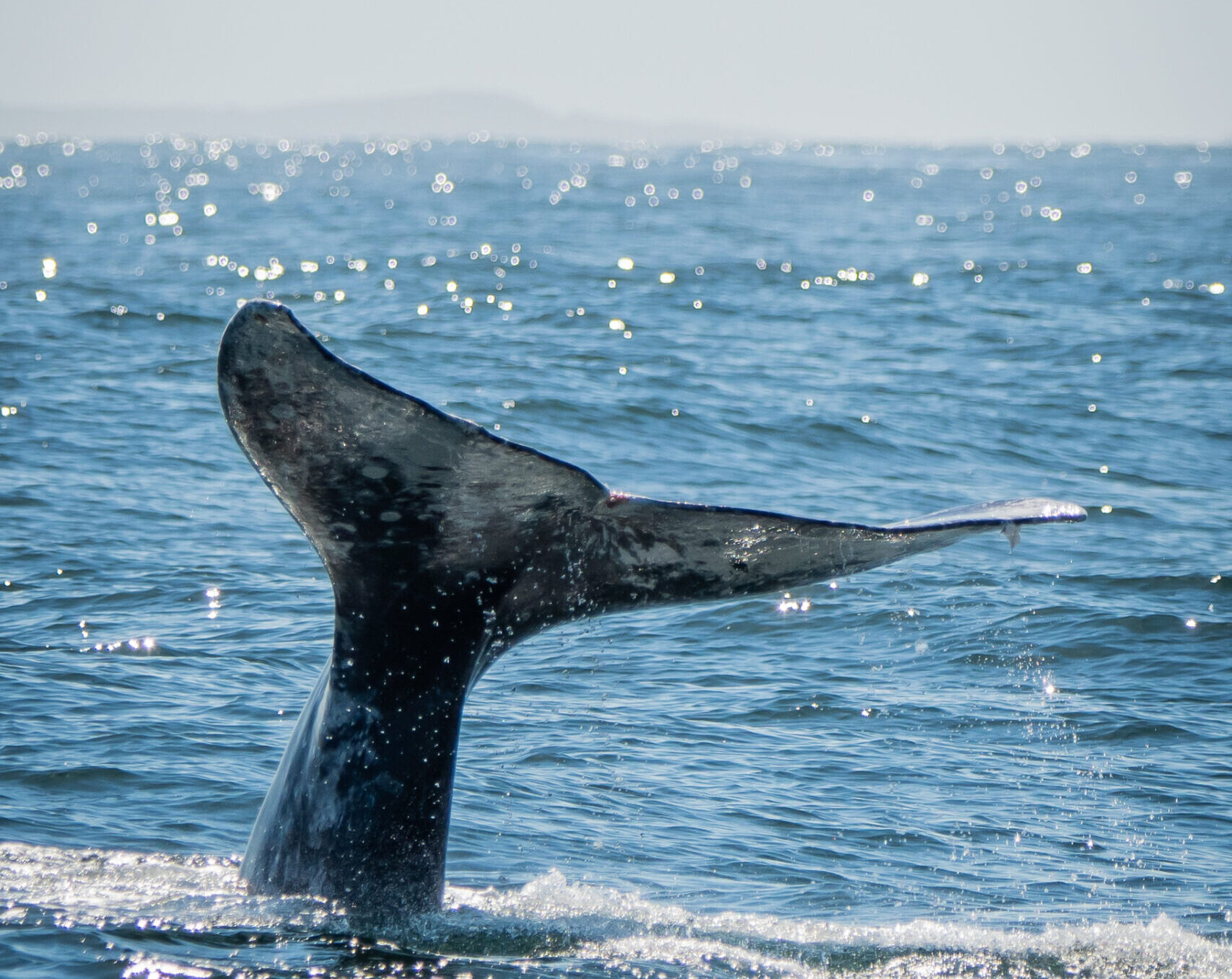
Every Spring, we celebrate the return of ḿaaʔak (Eastern North Pacific Grey Whales or Eschrichtius robustus) making their epic journey back up the west coast – the longest migration of any mammal. Imagine traveling a 12,000 kms return-circuit every year as these friendly giants move between winter calving grounds in Baja California, Mexico, hugging the coast of Vancouver Island, enroute to summer feeding grounds in the Bering, Chukchi, and Beaufort Seas. Some ḿaaʔak, part of the southern or Pacific Coast Feeding Group (PCFG), instead come home to Clayoquot and nearby Barkley Sounds.
They are soon followed by yayačam (Humpback whales or Megaptera novaeangliae) returning from areas like the Revillagigedo Archipelago in Mexico and from Central America as they head north to high latitude feeding grounds.
Both are baleen whales who filter-feed tiny marine creatures through baleen plates in their upper jaw.


“m’aaʔak and yayačam have traveled to and through their home in Nuučaanuł/Nuu-chah-nulth territories for many generations,” points out Gisele Martin, Tla-o-qui-aht Tribal Parks Guardian. “Their numbers were once huge, interconnected with the biodiversity safeguarded by Indigenous laws along the entire continent.”
“ʔiiḥtuup — ‘ʔiiḥ” meaning “enormous/of immense importance” and “tuup” meaning “living being” or “creature” were hunted by Nuučaanuł Nations over many generations in oceangoing canoes far offshore, before non-Indigenous commercial whale hunting severely reduced populations and colonial governments disrupted the Nuučaanuł ways of life.”
“tinwis, meaning calm waters, was a ƛaʔuukʷiʔatḥ summer village and an important place for anchoring whales once they were ceremoniously brought in from offshore.”
When you stay at oceanfront Tin Wis Resort, an Original Original and Authentic Indigenous world-class destination within ƛaʔuukʷiʔatḥ/Tla-o-qui-aht Tribal Parks, you are supporting Nuučaan̓uł cultural revitalization, biodiversity, and that profound connection with whales now through ecotourism.
“ƛaakašiis (Tonquin Beach) ‘stand on the beach’ is another Nuučaanuł name connected to whales. The day I learned the ƛaʔuukʷiʔatḥ place name of the beach, I paddled a traditional dugout canoe along that shore. As I came around the corner, I saw a whale in action, standing along the beach as it is described in the name.
“Indigenous place names reflect deep ecological knowledge and history spanning thousands of years,” explains Gisele.
“The return of the whales is part of a much larger and older celebration attended by many species, interconnected with the great herring spawn which boosts life along the whole coast,” emphasizes Gisele. “Much respect must be practiced to not disturb the herring spawn, and both ʕaḥuusʔatḥ/Ahousaht and ƛaʔuukʷiʔatḥ Nations have made important policy recommendations for boat traffic to avoid spawning areas.

“hišukʔiš c̓awak, meaning everything is one, interconnected, is a saying which illustrates the understanding that to protect the whales we must protect the whole marine environment, including the smallest fish and sea creatures.”
Gisele underscores a key protocol from Tla-o-qui-aht Tribal Parks’ ʔiisaak pledge: “qʷaasiinḥapin: Let us leave healthy habitats undisturbed, keeping them as they are for future generations of life.”
The continuity of Nuučaanuł stewardship of these lands and waters since time immemorial today includes ḥačxwiqaq (Deep Ocean) Tribal Park and Indigenous Cultural Conservancies protecting 76,000 hectares of biodiversity and blue carbon-rich Clayoquot Sound in a collaborative effort between Tla-o-qui-aht and Ahousaht, and the province of British Columbia.
Further, collaborative work between whale scientists and knowledge keepers has identified that Fin Whales (Balaenoptera physalus) and North Pacific Right Whales (Eubalaena Japonica) were once common in these waters, with recent sightings suggesting they’re returning.
Beyond the baleen whales who currently feed here in summer, Clayoquot Sound is home to kakaw̓in (Orcas or Orcinus orca), a toothed whale in the oceanic dolphin family.


Indigenous-led whale watching tours reflect that continuing connection with whales and this vibrant marine ecosystem. Knowledgeable guides offer insight into these incredible beings through a Nuučaanuł lens, often sharing stories and songs passed down from generation to generation.
A close encounter of the cetacean kind is a transformative experience whether you spot the “rainblow” from a spout in the distance or are surprised by a Grey whale surfacing nearby. Barnacled skin breaking through silver-dappled waters. All you can hear is your own heartbeat and the sound of the waves lapping against the hull of the boat, its motor silenced. Then an explosive exhale. Perhaps a pulse of sound that seems prehistoric. ḿaaʔak submerges mysteriously back out of sight, vanishing into the depths to feed on tiny invertebrate arthropods on the seafloor. Its only trace a whirlpool quickly absorbed by the current like a mirage.
And, your deepening sense of connection to this remarkable place.
Download the Indigenous BC App to explore authentic Indigenous-led experiences.
-30-