
November 7, 2025
Raising Maht-Mas-Uuthluuk — “The Chief that looks after his people”.
As told to Erin Linn McMullan
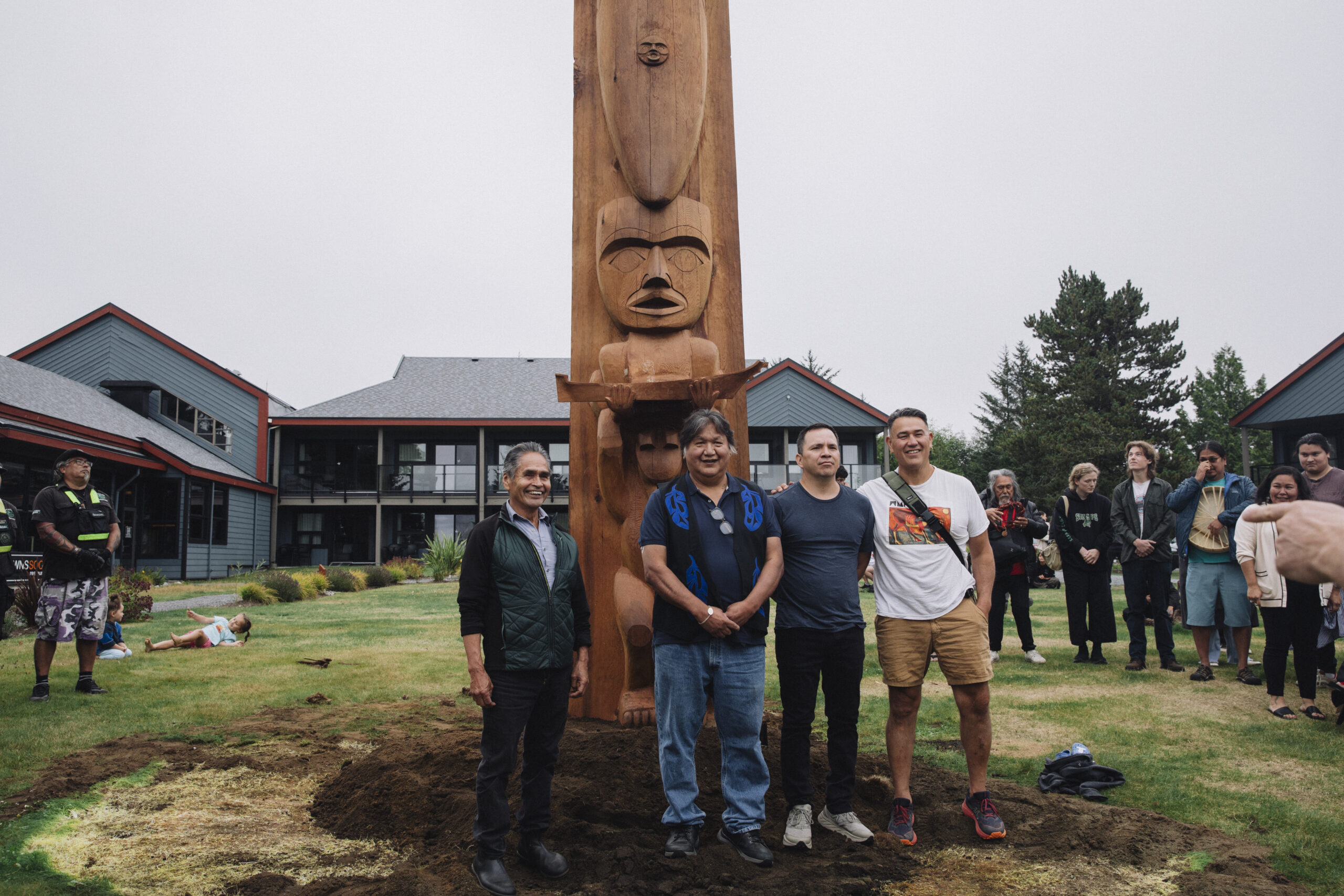
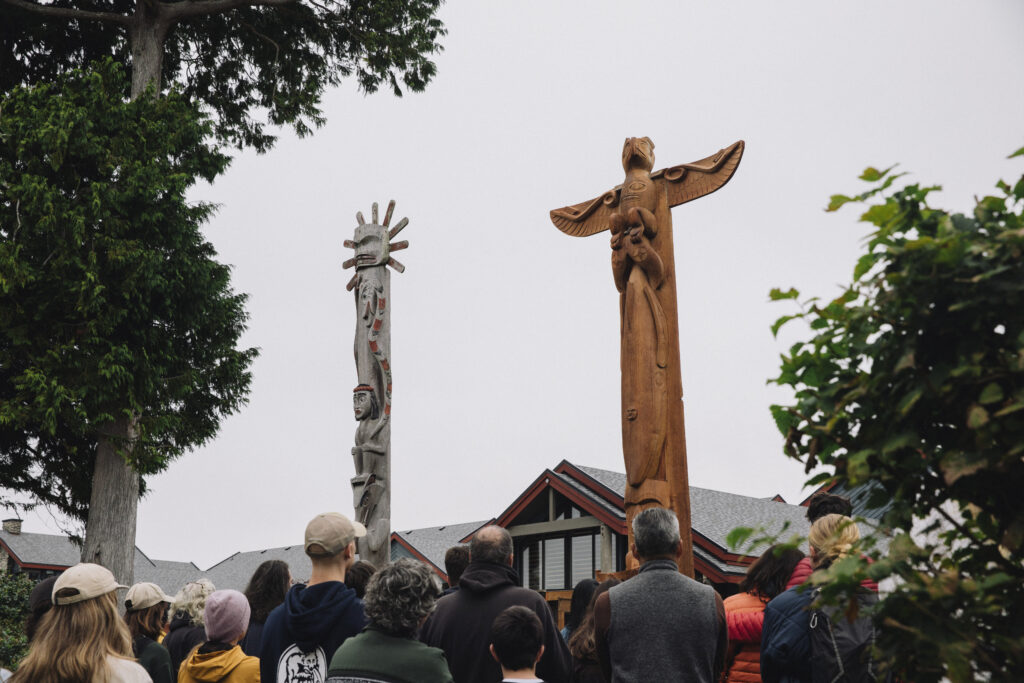
Facing beachfront, powerful t̓iick̓in (Thunderbird) surveys the Pacific Ocean alive with whitecaps and winter winds. Perched atop the cedar čiinuł (totem pole), his wings spread wide, he appears poised for flight. The serpents adorning his generous wingspan remind us to be aware of our surroundings, to steward this place, and to help when we can. This 23-foot-high hand raised čiinuł Maht-Mas-Uuthluuk – “The Chief that looks after his people” – honours Hiyoueah Seitcher, whose spirit it embodies both as a hereditary chief and a drug and alcohol counsellor working with Nuu-chah-nulth Peoples along the west coast.
“And that’s exactly why that thunderbird is sitting on top of that whale,” explains Tla-o-qui-aht Master carver Tutakwisnapšiƛ Joe Martin, “because of a chief’s responsibility to his people to feed them all, to go out and be a whale hunter and bring that whale back for his people.”
The figures depicted on this čiinuł were guided by Joe’s knowledge of the Seitcher family and the cultural protocols and teachings about their family. On this project, Joe worked alongside Tseshaht and Nuu-chah-nulth master carver Gordon Dick and Kelly Robinson, whose family origins are rooted in Bella Coola, with descendants from both the Nuxalk and Ahousaht nations.
“The top crest is usually the thunderbird, the ones with the wings open like that pole, that is depicting our male ancestry,” explains Joe, adding that, “On the male thunderbird is always depicted the crest of the sun because it has his teeth bared like that.
“The other thunderbird with the wings closed represents our female ancestry which will have the crest of the moon on its chest: the gentle one.
“The other crest you will find on the top of a totem pole is usually the crest of the sun or the moon,” he explains. “And they are on top because that is about the very first teaching and the first law, which is about respect. If it’s not on top of the totem pole, it’s always depicted on the chest of the thunderbird.”
Those teachings, he points out, were a really important part of Indigenous cultures. Joe’s own knowledge of these crests, songs, dances, and names of mountains were shared with him by his father, the late Robert Martin Sr., who held a university of knowledge, when they would go out fishing together.
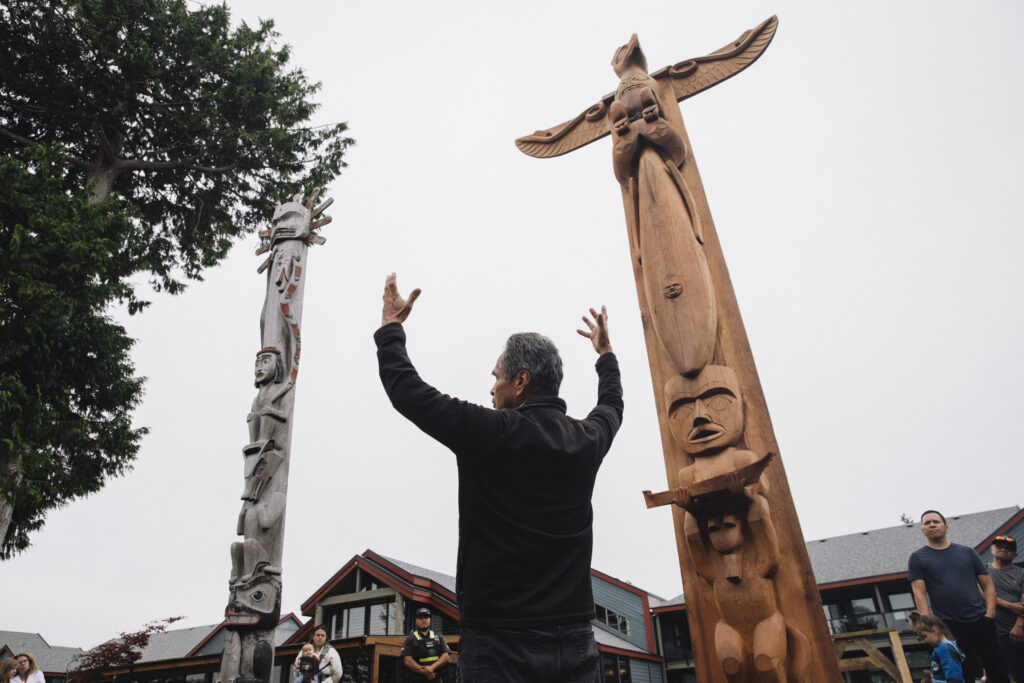
He continues describing the next figure beneath the whale, a human holding a canoe. This represents Raymond (Hiyoueah) Seitcher, whom Joe’s father spoke highly of, and the canoe carved by Joe and his late brother, Billy Martin, as a gift in thanks for all Hiyoueah gave to his community.
“I tried to adhere to a Tla-o-qui-aht style, especially when it’s carving out faces. Many of the other Nuu-chah-nulth poles that are around the coast still today I think they are very, very similar to each other in a way,” he suggests, pointing out that, “People may have their own little trademark that they put on a carving or a piece of art that they do.
“And then below that is the wolf. And that wolf is holding, supporting the whole totem pole with arms up like that,” he demonstrates the wolf’s gesture, showing how it is upholding the laws.
The top crest is the most important one, he emphasizes, with the bottom crest being the next most important – here, the wolf, and in other cases, the bear, and the killer whale.
Joe recalls that he began learning about čiinuł at a very young age. “My father, my parents, my grandparents as well, and other Elders that were in the village, our people did have a very different teaching system than Europeans.”
“You know, when we were here alone, these totem poles and all these art crests were a very important part of our culture. And art has been a very important aspect of humanity of the world over. Our people are no exception.
“And so certainly when Europeans arrived here, yes, we were illiterate. We could not read the things they had came with. But so were they when they’d seen our totem poles.” In fact, Captain Cook wrote in his logs, “grotesque figures carved onto a piece of wood”.
“My dad used to tell me that there used to be at least four totem poles in the front of every home,” Joe says, explaining that all of the families on the coast had them. “They all had the same teachings but they were expressed in different ways.”
Maht-Mas-Uuthluuk was funded by a Canada Council grant, enabling Joe to compensate the carvers as well as the men who assisted him in harvesting the log from where it was spearheaded in Kennedy Lake. He remembered having seen it there 20 or 30 years before. Originally 37-feet long, roughly five-and-a-half feet in circumference at the bottom, and four feet at the top, it was a very heavy log to handle.
“It was on such a steep bank,” says Gordon Dick, who went out to help along with his 20-year-old son, Kashus. “So it was quite the undertaking to get it off the hillside there. Joe took a few runs at it before Kashus and I made it out there. And fortunately, we were able to get it off the hillside and into the water.”
Since Naa’Waya’Sum Coastal Indigenous Gardens in Tofino was then undergoing construction, the log was transported to Gordon Dick’s Ahtsik Gallery in Port Alberni where his carving shelter and tools could facilitate large-scale projects like this.
“It’s great that Joe is pushing to have pieces for community,” says Gordon, who has worked alongside this mentor on three Tla-o-qui-aht čiinuł projects to date: Hinaaqsuuqʷa raised in Opitsaht on July 1, 2022, Naa’was (Listening to the land) at Naa’waya’sum in Tofino on August 1, 2023, and Maht-Mas-Uuthluuk at Tin Wis on August 27, 2025, all hand raised in the traditional way and without the use of a winch.
Gordon reflects back to the first two poles he worked on under mentor Tim Paul, of Hesquiaht, which were raised by Tseshaht over 20 years ago by crane.
“I’ve been fortunate to take part in the last three poles for the Tla-o-qui-aht Nation: these poles were raised historically. It’s great to have all the people, all that good energy there and to take part and then witness it.”
That earlier pole raising ceremony marked Gordon’s transition from jewelry maker to carver. “I did enjoy doing working with precious metal for years, but the wood – the smell, the feel, the sound, those are all very therapeutic.”
Working on Maht-Mas-Uuthluuk would present some challenges from removing rot to a fracture in the wood, reducing their cedar canvas to just shy of 30 feet – six feet of which would be anchored below the surface at Tin Wis.
“Joe, Kelly, and I, we milled it in half, and it was still an undertaking just with the weight of the material,” says Gordon. “As we worked it down, it started to do its movement but there was a lot of soft rot from base to top.” They removed it before flipping the log, making it lighter and more stable for drying and curing time. “It will still always move, as my naniiqsu, my old mum would say, ‘It’s alive.’”
While Joe understands the material intuitively, Gordon and Kelly are more structured in their approach. “It gave me the opportunity to exercise my eye,” says Gordon, “and to reestablish carving with both hands, drawing, designing with both hands.”
After the initial blocking out with chainsaws, the carvers used elbow adzes, large chisels and gouges, slicks and custom knives acquired over the years – some blacksmiths focus on West coast style hook knives and curved knives.
Gordon credits Kelly, whom he first met when he opened his gallery 17 years ago, with teaching him to slow down and open his “student eyes” and ultimately, discover the flow and signature within Nuu-chah-nulth art.
“Kelly’s a phenomenal artist,” he emphasizes. “And he and I really work well and feed off each other with design and proportions and ideas.”
Kelly’s understanding of scale would be vital. “It gets a little difficult when you’re in a big scale because everything’s proportions and transitions. If you can’t get it right, if something doesn’t complement another piece of the big sculpture, you’re going to be stuck again. And that comes back to design and being able to scale up and scale down.
“Everything in Northwest Coast Art is based off of design,” says Kelly, who studied at the Freda Diesing School of Northwest Coast Art in Terrace. “But when I learned their design, I had to relearn my roots, which is my mother’s Nuxalk from Bella Coola and my father’s Ahousaht. In Nuu-chah-nulth art, I have a lot to learn.
“I really enjoyed listening to Joe, what he got taught from his father and his grandad are wholesome truthful teachings. With Joe, because he can speak the language, it really means a lot when those words or said or just his knowledge of that t̓iick̓in that’s up on top or that whale or ʔiiḥtuup.
“I’ve been fortunate to run into exceptional Northwest Coast artists who passed on their knowledge,” advising, “You have to find an intuitive balance of your own artistic ways.
“It’s all about the spirit and vibrance of song, mask, dance, language,” emphasizes Kelly. “It’s all integrated into becoming a better human being. The thing about cedar is it’s used as medicine. It’s used for everything on the Northwest Coast.” While he worries about challenges to salmon and old-growth cedar over the next 50 years, Kelly envisions art becoming vibrant again within these coming generations.
“I think West Coast First Nations Art in its entirety is just in its infancy in regards to the public awareness on the worldwide stage,” suggests Gordon. “We need more Nuu-chah-nulth artists.”
-30-